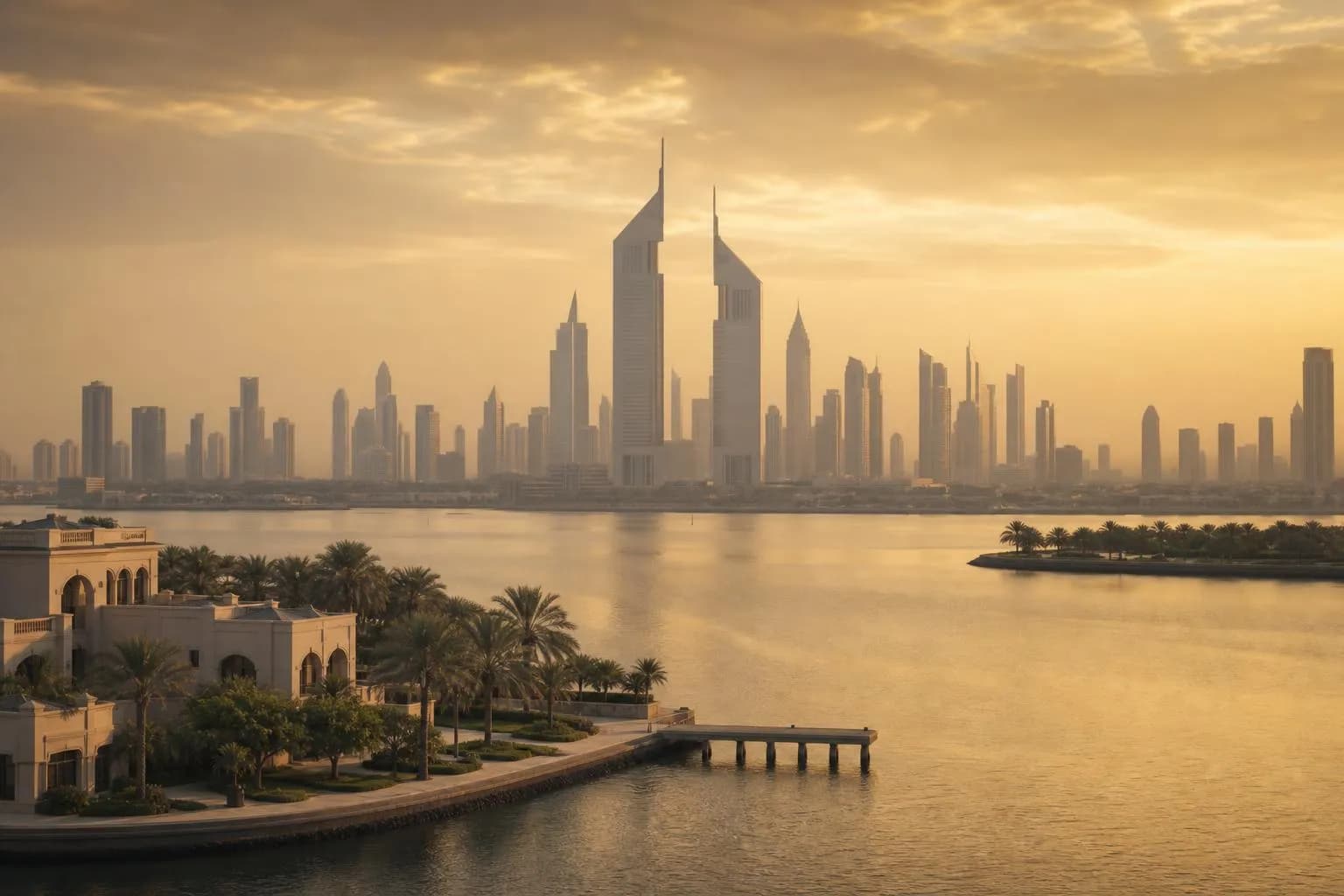
What Is the Dubai Sovereign Wealth Fund and How Much Does It Manage?
The Dubai sovereign wealth fund most people mean when they use that phrase is the Investment Corporation of Dubai (ICD), established in 2006 to consolidate the Dubai government's commercial holdings under a single entity. As of its most recent annual report, ICD reported total assets of approximately AED 1.17 trillion, roughly $318 billion USD. That is a large number, but context matters: it is not Abu Dhabi's ADIA.
This conflation is one of the more persistent errors in mainstream financial coverage. Dubai and Abu Dhabi are separate emirates with separate sovereign vehicles. ADIA, the Abu Dhabi Investment Authority, is estimated by the Sovereign Wealth Fund Institute at over $900 billion AUM and operates as a passive, diversified financial investor. ICD is structurally different: it holds controlling or significant stakes in operating companies, not a passive index-style portfolio. The risk and return profile is fundamentally distinct, and if you are benchmarking Gulf exposure, treating them as interchangeable is a mistake.
Dubai World, a separate government-related entity, also manages a significant portfolio of assets including DP World and Nakheel. But ICD is the primary vehicle for the Dubai government's investment operations and the one institutional investors track most closely.
How the Investment Corporation of Dubai Differs from Abu Dhabi's Sovereign Funds
ICD's portfolio reads more like a conglomerate than a traditional sovereign wealth fund. Its major holdings include Emirates Group (the airline and aviation services business), Emirates NBD (one of the largest banks in the Middle East by assets), ENOC (Emirates National Oil Company), and Emaar Properties, the developer behind the Burj Khalifa and Dubai Mall.
These are not passive financial positions. They are controlling stakes in businesses that generate operating cash flows, employ hundreds of thousands of people, and anchor Dubai's non-oil economy. That structure creates a different risk profile than ADIA's globally diversified financial portfolio or the world's largest sovereign wealth fund, Norway's Government Pension Fund Global, which holds over $1.6 trillion in publicly traded equities, bonds, and real estate with full holdings transparency.
The ICD model is closer to Singapore's Temasek than to Norway's GPFG. Temasek holds concentrated stakes in Singapore-linked operating companies (DBS, Singapore Airlines, Singapore Telecom) while also investing internationally. Other major Asian sovereign investors like GIC take a more passive, diversified approach. The distinction matters when you are assessing what an SWF's investment decisions actually signal about deal quality versus strategic or political objectives.
For institutional investors and FATFIRE-level individuals evaluating Gulf exposure, ICD's concentrated, operating-company structure means its performance is more correlated to Dubai's economic cycle than to global market beta. That is a feature or a bug depending on your existing portfolio construction.
What Companies and Assets Does Dubai's Sovereign Wealth Fund Own?
ICD's portfolio spans five primary sectors: transport and logistics, banking and financial services, energy, real estate, and diversified industrials. The table below summarizes the key holdings by sector based on ICD's published annual reports.
| Sector | Key Holdings | Notes |
|---|---|---|
| Aviation and Transport | Emirates Group, dnata, DP World (via Dubai World) | Emirates is the largest long-haul airline globally by international passengers |
| Banking and Financial Services | Emirates NBD, Dubai Islamic Bank | Emirates NBD is among the top 5 banks in the MENA region by assets |
| Energy | ENOC (Emirates National Oil Company) | Integrated oil and gas, retail fuel, and aviation refueling |
| Real Estate and Hospitality | Emaar Properties, Jumeirah Group | Emaar developed the Burj Khalifa and Dubai Mall; Jumeirah operates luxury hotels globally |
| Diversified / Industrial | DEWA (Dubai Electricity and Water Authority) | DEWA listed on DFM in 2022 in one of the region's largest IPOs |
This is not a diversified passive portfolio. It is a concentrated bet on Dubai's continued growth as a global hub for aviation, finance, real estate, and tourism. When Dubai's economy runs hot, ICD's portfolio benefits disproportionately. When it contracts, as it did during the 2009 Dubai World debt crisis, the concentration risk becomes visible quickly.
The 2009 episode is worth remembering. Dubai World's request for a debt standstill on approximately $26 billion in obligations rattled global credit markets and required an Abu Dhabi bailout. ICD itself was not the distressed entity, but the episode illustrated the interconnectedness of Dubai's government-linked entities and the opacity that makes stress scenarios hard to model from the outside.
How Dubai's Sovereign Wealth Fund Compares to Norway's and Singapore's
Governance transparency is where the comparison gets uncomfortable for ICD. The Sovereign Wealth Fund Institute publishes the Linaburg-Maduell Transparency Index, scoring funds on a 1-to-10 scale. Norway's GPFG scores a 10. Singapore's GIC scores an 8. Most Gulf-region funds, including ICD, score materially lower due to limited public disclosure of holdings, performance data, and fee structures.
The table below compares the major sovereign wealth funds across the dimensions that matter most to institutional investors.
| Fund | Country | Est. AUM (2024) | Transparency Score | Primary Strategy | Benchmark Return |
|---|---|---|---|---|---|
| Norway GPFG | Norway | $1.6T+ | 10/10 | Passive, diversified (70% equity / 30% fixed income) | Full public disclosure |
| ADIA | Abu Dhabi | $900B+ | 6/10 | Diversified, passive financial assets | 20-yr annualized: ~6.9% (self-reported) |
| GIC | Singapore | $770B+ (est.) | 8/10 | Diversified, long-horizon | 20-yr real return: ~4.6% above global inflation |
| Temasek | Singapore | $380B+ | 8/10 | Concentrated operating company stakes | 20-yr TSR: ~9% (self-reported) |
| ICD | Dubai | ~$318B | 4/10 | Concentrated operating company stakes | Limited public disclosure |
| PIF | Saudi Arabia | $700B+ | 4/10 | Diversified, domestic transformation focus | Limited public disclosure |
| QIA | Qatar | $475B+ | 5/10 | Diversified, real estate and luxury brands | Limited public disclosure |
Sources: Sovereign Wealth Fund Institute (2024), NBIM Annual Report (2023), GIC Report (2023), Temasek Review (2023).
Norway's GPFG publishes every single holding. You can look up its exact position in any publicly traded company on any given day. ICD's annual report discloses consolidated financials and sector breakdowns but does not publish granular performance attribution or individual holding valuations. For an investor trying to use SWF activity as a market signal, the information asymmetry is significant.
The IMF's Santiago Principles, established in 2008, set out 24 voluntary governance and transparency standards for sovereign wealth funds. Adherence is voluntary, and Gulf-region funds have been selective in their adoption. Norway built its entire fund governance model around maximum transparency as a political and institutional commitment. Gulf funds have generally prioritized operational flexibility over disclosure.
Can Foreign High-Net-Worth Investors Co-Invest Alongside Dubai's Sovereign Wealth Fund?
Not directly, and not easily. ICD does not offer co-investment vehicles to outside investors. Its portfolio companies are either privately held by the Dubai government or publicly listed on the Dubai Financial Market (DFM) or Abu Dhabi Securities Exchange (ADX), where any investor can buy shares.
The more practical access point for FATFIRE-level investors is through private equity. According to Preqin's research on sovereign wealth fund allocations, Gulf-region SWFs including ICD-affiliated entities have increasingly committed capital as anchor limited partners in top-tier global private equity funds. If you have access to institutional-quality PE vehicles with $1M to $5M minimums, you may already be a co-LP alongside GCC sovereign capital in the same fund structures.
This matters for two reasons. First, SWF anchor commitments to a PE fund signal institutional validation of the manager and strategy. Second, GCC sovereign capital tends to be long-horizon and low-turnover, which stabilizes fund dynamics and reduces pressure for premature exits. McKinsey's foundational analysis of SWF investment behavior documented this stabilizing characteristic explicitly: SWFs tend to provide patient capital during market dislocations, which benefits other LPs in the same vehicles.
For private equity opportunities in Dubai specifically, the DFM and ADX list several ICD portfolio companies including Emaar Properties and DEWA. These are liquid, publicly traded access points to the same underlying assets ICD holds, without the governance opacity of the fund itself.
Sovereign wealth fund private equity strategies have also evolved significantly over the past decade, with Gulf SWFs moving from passive LP positions toward direct deals and co-investments that bypass fund fees entirely. As a FATFIRE investor, understanding where SWF capital is flowing in private markets can inform your own allocation decisions.
Tax Implications for US Investors with UAE Exposure
This section matters more than most articles on this topic acknowledge. The US and UAE do not have a comprehensive bilateral income tax treaty as of 2024. That single fact has significant consequences for US persons investing in UAE-domiciled structures.
Without a treaty, US investors receive no treaty-based relief from US taxation on UAE-sourced investment income. The UAE itself imposes no individual income tax and no capital gains tax, which looks attractive on the surface. But the absence of a US-UAE tax treaty means the apparent tax efficiency of UAE structures does not translate into actual tax savings for US persons. You still owe US tax on worldwide income.
The specific compliance landmines:
PFIC Rules. If you invest in a UAE-domiciled fund or pooled vehicle that qualifies as a Passive Foreign Investment Company, you face punitive US tax treatment on gains and distributions unless you make a Qualified Electing Fund (QEF) election. Many UAE-domiciled structures do not provide the information required to make a QEF election, which means you default into the excess distribution regime with interest charges applied to deferred gains.
FBAR and FATCA. Any US person with a financial interest in or signature authority over a foreign financial account exceeding $10,000 must file FinCEN Form 114. FATCA (Form 8938) applies at higher thresholds. Direct investment in UAE accounts or funds triggers both.
Foreign Sovereign Immunities Act. The IRS Publication 515 notes that sovereign entities may claim certain exemptions from US withholding, but these exemptions apply to the sovereign, not to US investors co-investing alongside them. The exemption does not flow through to you.
The practical implication: if you are considering direct UAE investment exposure beyond publicly traded DFM or ADX equities (which are straightforward to hold in a US brokerage account), run the structure past a tax attorney with international experience before committing capital. The compliance costs and potential PFIC exposure can materially erode returns that look compelling on a pre-tax basis.
For wealth management strategies for ultra-high net worth individuals with international exposure, the UAE is an attractive operating base precisely because of its zero personal tax environment. For US persons, that benefit is largely irrelevant unless you are a resident there.
How Dubai's Sovereign Wealth Fund Affects Private Equity and Real Estate Valuations Globally
When a sovereign wealth fund with $300 billion-plus in assets decides to increase its allocation to a sector, it moves prices. The mechanism is straightforward: SWFs are price-insensitive buyers relative to return-maximizing private investors, and their entry into a market compresses yields and inflates valuations for everyone who follows.
The Gulf SWFs' shift toward alternative assets has been one of the more consequential structural trends in private markets over the past decade. Preqin's data documents the growing allocation by Gulf-region SWFs to private equity, infrastructure, and real assets as a diversification strategy away from public market volatility. When ADIA, Mubadala, QIA, and ICD-affiliated entities are all competing for the same infrastructure assets or trophy real estate, cap rates compress and entry multiples expand.
This dynamic has direct implications for FATFIRE investors in the same asset classes. If you are allocating to core real estate or infrastructure funds, you are competing with sovereign capital for the same assets. The good news is that SWF presence in a fund or asset class signals institutional quality. The bad news is that it also signals compressed future returns.
Dubai's broader economic landscape has benefited directly from this dynamic. The influx of sovereign and private capital into Dubai real estate over the past five years has driven residential and commercial valuations to record levels. For investors who entered early, the returns have been exceptional. For those entering now, the risk-reward calculus is different.
Other Gulf state sovereign wealth funds and comparable Middle Eastern investment vehicles operate with similar dynamics at smaller scale. Kuwait's KIA, one of the oldest sovereign wealth funds in the world, has historically maintained a conservative, diversified approach that contrasts with the more aggressive deployment strategies of Dubai and Saudi Arabia's PIF.
Investment Lessons from the ICD Model for FATFIRE Portfolios
The ICD structure offers a few genuinely transferable insights for managing a $5M to $50M+ private portfolio, separate from any direct investment in Dubai-linked assets.
Concentrated operating company exposure is a different risk than financial asset diversification. ICD's portfolio is not diversified in the traditional sense. It holds large stakes in a small number of businesses that are deeply linked to a single city's economic trajectory. That concentration has generated substantial wealth creation over two decades. It has also produced moments of acute stress. The lesson is not to replicate the concentration, but to be honest about what your own portfolio actually looks like when you strip away the labels. A FATFIRE portfolio with $8M in a single tech company stock, $3M in local real estate, and $2M in a business you founded is structurally more similar to ICD than to Norway's GPFG.
Transparency has a price, and opacity has a cost. ICD's low Linaburg-Maduell score reflects limited public disclosure. For a government entity, that is a governance risk that institutional investors price in. For a private individual, the equivalent is the opacity of your own family office or holding structure. The investors who have the clearest picture of their actual risk exposures, correlations, and liquidity profiles consistently make better decisions under stress.
Patient capital outperforms when deployed with discipline. McKinsey's analysis of SWF behavior noted that sovereign funds tend to be stabilizing, long-horizon investors. The FATFIRE equivalent is the decision to hold illiquid positions through market dislocations rather than forcing liquidity at the worst moment. The structural advantage of not needing to mark to market or meet redemption requests is significant. Most FATFIRE investors have this advantage and underuse it.
For high net worth investment opportunities in the Gulf region specifically, the most accessible and transparent options remain publicly listed equities on the DFM and ADX, or exposure through institutional PE funds where GCC sovereign capital is already a co-LP. Direct UAE-domiciled fund structures require careful tax structuring for US persons and are generally not worth the compliance complexity unless you have a compelling specific opportunity and experienced legal counsel.
Asia's rising wealth and investment influence is increasingly intersecting with Gulf capital flows, particularly in infrastructure, technology, and real estate. Understanding where these capital pools overlap can identify sectors with multiple large, patient buyers, which tends to support valuations over time.
The Middle East Sovereign Wealth Ecosystem: Positioning Dubai Within It
Dubai's ICD does not operate in isolation. The GCC sovereign wealth ecosystem is one of the largest concentrations of state-controlled capital on the planet, and the funds within it have distinct mandates, strategies, and risk profiles.
Saudi Arabia's Public Investment Fund (PIF), under Crown Prince Mohammed bin Salman, has grown from roughly $150 billion in 2016 to over $700 billion in estimated AUM by 2024. PIF's strategy is explicitly transformational: it is deploying capital into domestic megaprojects (NEOM, Red Sea tourism) and international technology investments (SoftBank Vision Fund, Lucid Motors, Newcastle United) with a mandate to diversify Saudi Arabia's economy away from oil by 2030. The return expectations embedded in some of these investments are aggressive, and the governance transparency is limited.
Qatar's QIA has taken a different path, building a portfolio of high-profile Western assets including stakes in Volkswagen, Barclays, and Harrods, and significant European real estate. QIA's strategy is partly financial and partly reputational: it uses investment activity to build Qatar's global profile and relationships.
Abu Dhabi runs multiple vehicles. ADIA is the largest and most passive. Mubadala is more active and operationally engaged, with a significant technology and private equity focus. ADQ is the newest and most domestically focused.
Within this ecosystem, ICD is the smallest of the major Gulf SWFs and the most concentrated in a single city's operating companies. That makes it the highest-beta play on Dubai's continued success as a global hub, and the most vulnerable to a Dubai-specific economic shock. For investors using SWF activity as a signal for regional allocation decisions, understanding which fund is moving and why requires knowing these structural differences.
The global statistics on very high net worth individuals show the Gulf region producing an accelerating share of new ultra-high-net-worth wealth, which creates private capital flows that complement and sometimes compete with sovereign fund deployment. The interaction between sovereign and private capital in Dubai's real estate and private equity markets is one of the more interesting structural dynamics in global alternative assets right now.
References
- Sovereign Wealth Fund Institute (SWFI) -- "Sovereign Wealth Fund Rankings by Assets Under Management" (2024)
- Investment Corporation of Dubai -- "ICD Annual Report" (2023)
- International Monetary Fund (IMF) -- "Santiago Principles: Generally Accepted Principles and Practices for Sovereign Wealth Funds" (2008)
- Norges Bank Investment Management (NBIM) -- "Government Pension Fund Global Annual Report" (2023)
- GIC (Government of Singapore Investment Corporation) -- "GIC Report on the Management of the Government's Portfolio" (2023)
- Preqin -- "Sovereign Wealth Funds in Alternative Assets Report" (2023)
- Internal Revenue Service (IRS) -- "Publication 515: Withholding of Tax on Nonresident Aliens and Foreign Entities" (2024)
- McKinsey Global Institute -- "Sovereign Wealth Funds: Barbarians at the Gate or Welcome Guests?" (2008)