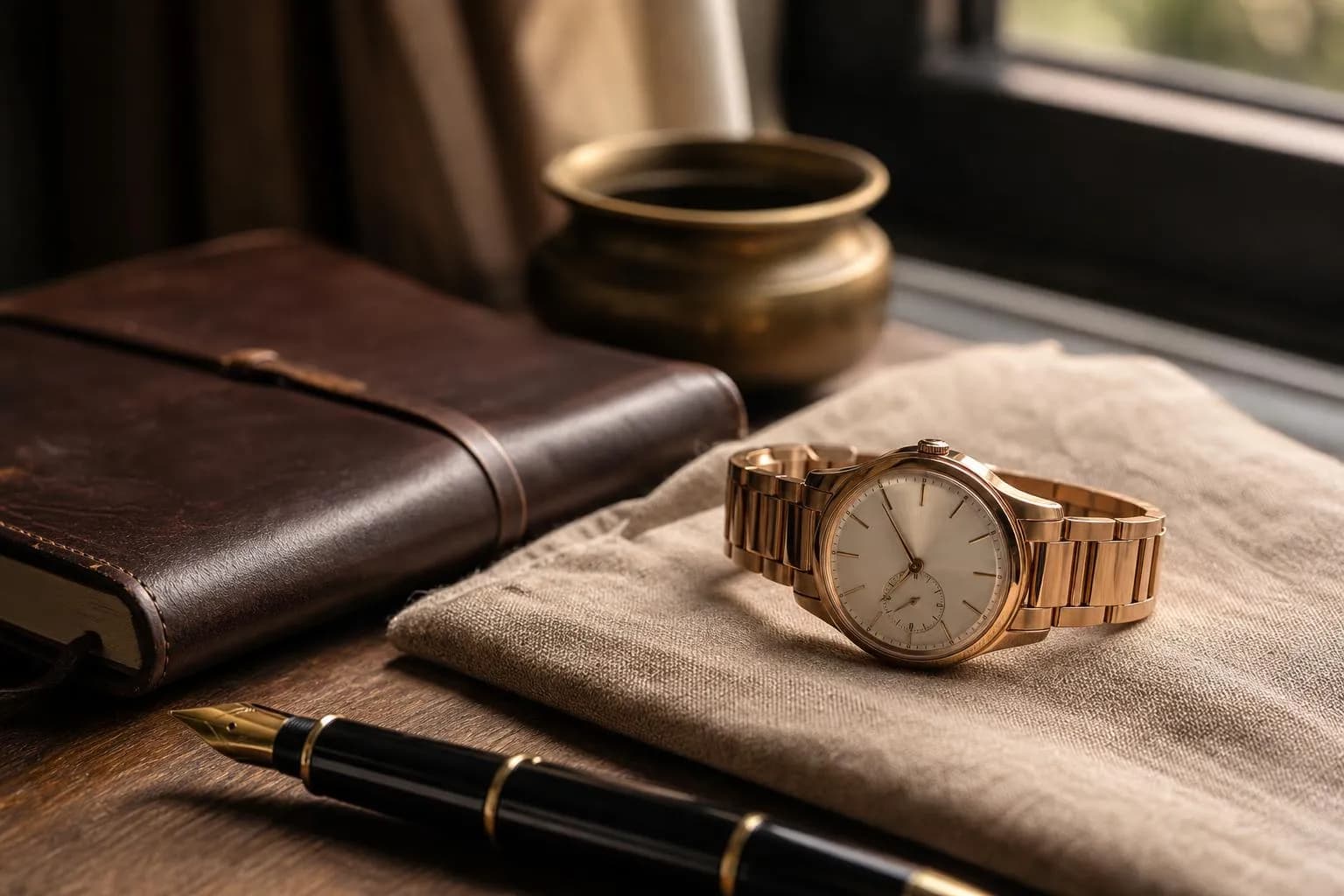
The Case for Stealth Wealth Watches
The best stealth wealth watches share one defining quality: they cost more than anyone around you suspects. For the $5M+ collector, that asymmetry is the point. This isn't about hiding wealth from the IRS. It's about wearing something that rewards the wearer's knowledge rather than performing for an audience that doesn't share it.
The market for understated, high-craft timepieces has matured considerably. According to Deloitte's 2023 Swiss Watch Industry Study, investment potential and value retention have become primary purchase motivations for high-net-worth buyers, with a meaningful share of collectors now treating watches as alternative assets within a diversified portfolio. That shift changes how you should think about acquisition, holding strategy, and exit.
What Actually Defines a Stealth Wealth Watch
The term gets applied loosely. A $6,000 Rolex Oyster Perpetual is not a stealth wealth watch in any meaningful sense for this audience. It's a fine entry-level piece from a brand that virtually everyone recognizes. Calling it "under the radar" confuses price accessibility with genuine discretion.
A true stealth wealth watch has three characteristics working together:
Minimal brand signaling. The logo is small, recessed, or absent. A stranger on the street cannot identify the brand at a glance.
Verifiable craft at the movement level. The case and dial are restrained because the watchmaker's reputation rests on what's inside, not on surface decoration.
Production scarcity that creates defensible value. F.P. Journe produces under 900 watches per year across all references. Philippe Dufour's Simplicity has fewer than 250 examples in existence. That scarcity is structurally different from a brand producing 800,000 units annually and calling a plain-dial variant "understated."
The distinction matters because the ultra-high net worth lifestyle and culture around collecting has shifted. Wearing something that only a fellow collector recognizes is a social signal in itself, just a more selective one.
Which Luxury Watch Brands Appreciate in Value Like Investments
Performance varies enormously by brand, reference, and holding period. The Wall Street Journal documented that secondary market prices for many popular references declined 20 to 40 percent from their 2021 to 2022 pandemic-era peaks, which should permanently retire the idea that watches are a one-directional asset class.
That said, Knight Frank's Luxury Investment Index (KFLII) tracks rare watches as a distinct asset class and has historically shown select watch categories outperforming many traditional assets over 10-year periods, even accounting for recent corrections.
The WatchCharts Overall Market Index, which tracks secondary market prices for the 30 most-traded references, provides the most granular real-time data. The divergence between mass-market luxury references and genuinely scarce independent watchmaker pieces has widened since 2022. Brands with verifiable, extremely limited production held value better through the correction.
| Brand | Approx. Annual Production | Entry Price (New) | Investment Profile |
|---|---|---|---|
| F.P. Journe | ~900 pieces | $25,000 – $80,000+ | Strong auction premiums; Christie's records document multiples above retail for key references |
| Philippe Dufour | ~10–15 pieces | $250,000+ | Fewer than 250 Simplicity examples exist; auction results consistently above retail |
| Kari Voutilainen | ~50 pieces | $80,000 – $150,000+ | Extreme scarcity; limited secondary market data but strong collector demand |
| A. Lange & Söhne | ~5,000 pieces | $15,000 – $200,000+ | Sotheby's records show consistent premiums on key references; strong long-term retention |
| Vacheron Constantin (Patrimony) | Not disclosed | $20,000 – $60,000+ | Stable; less speculative upside than independents |
| Patek Philippe (Calatrava) | Not disclosed | $25,000 – $80,000+ | Historically strong retention; less volatile than sports references |
| Nomos Glashütte | ~15,000 pieces | $2,000 – $8,000 | Minimal investment case; strong value-per-dollar, not appreciation play |
The honest summary: watches from independent makers with sub-1,000 annual production have the most defensible long-term value argument. Everything else requires more scrutiny.
Stealth Wealth Watches by Price Tier
Price context matters. Here are specific references worth considering at each level, with the caveat that secondary market prices shift and you should verify current WatchCharts data before purchasing.
| Price Tier | Brand / Reference | Approx. Price | Why It Qualifies |
|---|---|---|---|
| Entry ($5K – $25K) | Nomos Glashütte Tangente | $2,500 – $5,000 | Bauhaus restraint, in-house movement, near-zero brand recognition outside collectors |
| Entry ($5K – $25K) | Grand Seiko SBGX261 | $4,000 – $7,000 | Zaratsu-polished case finishing rivals watches at 5x the price; invisible to non-collectors |
| Mid ($25K – $100K) | A. Lange & Söhne Saxonia Thin | $25,000 – $35,000 | German manufacture, three-quarter plate movement, minimal dial; recognized only by the initiated |
| Mid ($25K – $100K) | F.P. Journe Octa Automatique | $30,000 – $55,000 | Sub-900 annual production; brass movement; auction records show consistent appreciation |
| Mid ($25K – $100K) | Vacheron Constantin Patrimony | $20,000 – $45,000 | One of the oldest continuously operating manufacturers; clean dial, no complications |
| Upper ($100K+) | Philippe Dufour Simplicity | $250,000+ | Fewer than 250 exist; the definitive stealth wealth collector's piece |
| Upper ($100K+) | Kari Voutilainen Vingt-8 | $80,000 – $150,000+ | ~50 pieces per year; Finnish-made movement; known only within serious collector circles |
| Upper ($100K+) | Patek Philippe Calatrava Ref. 5196 | $30,000 – $50,000 | Understated by Patek standards; strong long-term retention data |
The Cartier Tank and Jaeger-LeCoultre Reverso both belong on a broader luxury list. For this specific audience, neither qualifies as genuinely under the radar. Both are widely recognized across income levels.
What Watches Do Billionaires and Ultra-Wealthy Actually Wear
The pattern among self-made ultra-high-net-worth individuals skews toward independent watchmakers and historically significant references rather than the brands that dominate retail advertising. This reflects the same logic behind understated luxury in fashion: the signal is legible only to peers who share the reference frame.
Warren Buffett famously wears a Rolex Datejust. That's a deliberate choice about projection, not a horological statement. At the other end, collectors like John Mayer have publicly documented collections built around F.P. Journe and independent makers, which has increased visibility for those brands among a certain audience.
The practical observation: among people with $50M+ in net worth, the most common pattern is a small, curated collection rather than a large one. Three to five watches, each chosen for a specific reason, with at least one independent maker reference. The stealth wealth approach to personal style extends naturally to watches: fewer, better, chosen for reasons that don't require explanation to strangers.
How Luxury Watches Are Taxed When Sold at a Profit
This is where standard watch content fails the FatFIRE reader entirely, and the gap is significant.
The IRS classifies watches as collectibles under IRC Section 1(h)(4), subject to a maximum long-term capital gains rate of 28 percent, not the 20 percent maximum that applies to most other long-term capital assets. For a collector in the top federal bracket, that difference is not trivial.
On a $200,000 gain from a watch sale, the federal tax is $56,000 at the collectibles rate versus $40,000 on an equivalent stock gain. That's a $16,000 difference before state taxes. In California or New York, state taxes eliminate the long-term/short-term distinction for collectibles entirely, pushing the combined marginal rate above 40 percent in some cases.
Additionally, under IRC Section 408(m), collectibles including watches are prohibited investments within IRAs. You cannot hold a watch inside a tax-advantaged retirement account, which eliminates the tax-sheltering strategies available for other alternative assets.
The estate planning angle changes the calculus considerably. Watches held at death currently receive a stepped-up cost basis under IRC Section 1014. A watch purchased for $30,000 that appreciated to $150,000 passes to heirs at the $150,000 basis, erasing $120,000 in taxable gain under current law. For collectors who intend to pass a collection to heirs rather than liquidate during their lifetime, the 28 percent collectibles rate may never apply. That makes long-term holding of appreciating watches more tax-efficient than the headline rate suggests.
| Scenario | Federal Tax Rate | $200K Gain Tax Cost | Notes |
|---|---|---|---|
| Watch sold during lifetime (LT) | 28% | $56,000 | IRS collectibles rate under IRC 1(h)(4) |
| Stock sold during lifetime (LT) | 20% | $40,000 | Standard long-term capital gains rate |
| Watch held until death | 0% on embedded gain | $0 (stepped-up basis) | IRC Section 1014; heirs inherit at FMV |
| Watch in IRA | Prohibited | N/A | IRC Section 408(m) bars collectibles in IRAs |
Consult your tax attorney before framing any watch purchase as an investment. The tax treatment alone should inform whether you structure a collection as a personal holding or through an entity, and whether your wealth management strategies for substantial assets account for collectibles exposure.
What High-Net-Worth Collectors Should Know Before Buying
The secondary market is where the most interesting references trade, and it's also where the most risk concentrates.
The Swiss Federal Institute of Intellectual Property has identified counterfeit watches as one of the largest categories of seized counterfeit goods globally. The sophistication of the counterfeit market is high enough that experienced dealers are occasionally deceived. For any watch above $20,000 purchased outside an authorized dealer, independent authentication is not optional.
Practical authentication steps:
- Request service history and original papers. A Lange or Patek without box and papers trades at a meaningful discount for a reason.
- Use the manufacturer's service center for authentication on high-value pieces. Most major houses will inspect and certify a watch for a fee.
- For independent verification, services like WatchCSA provide third-party authentication that is increasingly accepted by major auction houses.
- On auction purchases through Sotheby's or Christie's, review the condition report carefully. Both houses provide specialist authentication, but their liability is limited by the terms of sale.
Beyond authentication, insurance requires attention. Standard homeowner's policy riders are inadequate for meaningful watch collections. Insurers including Chubb, AIG Private Client, and PURE offer scheduled personal property coverage, but collections exceeding $500,000 in value typically trigger storage and security requirements, plus mandatory independent appraisals updated every two to three years.
Appraisal costs, insurance premiums, and secure storage are real carrying costs that reduce net investment returns. Factor them into any ROI analysis before treating a watch collection as a straightforward alternative investment. These are the same considerations that apply to investment opportunities for affluent investors in any illiquid asset class.
The Best Stealth Wealth Watches Under $50,000
The $25,000 to $50,000 range is where the stealth wealth argument is strongest. You're above the threshold where brand recognition drives most of the price, but below the level where independent maker scarcity becomes the dominant factor.
A. Lange & Söhne Saxonia Thin. At roughly $25,000 to $35,000, this is the clearest expression of German watchmaking restraint. The three-quarter plate movement visible through the caseback is a technical statement that requires no explanation to anyone who understands it, and no explanation is possible to anyone who doesn't. Sotheby's auction results document consistent premiums on Lange references at secondary market.
F.P. Journe Octa Automatique. In the $30,000 to $55,000 range, this is the entry point into a maker producing under 900 pieces annually. Christie's records document that key F.P. Journe references have achieved significant premiums above retail at auction. The brass movement is a deliberate technical choice, not a cost-cutting measure.
Vacheron Constantin Patrimony. One of the oldest continuously operating watch manufacturers in the world, Vacheron's Patrimony line runs $20,000 to $45,000 for core references. The dial is almost aggressively plain. The brand is known to collectors but invisible to most.
Grand Seiko SBGX261. At roughly $4,000 to $7,000, this sits below the typical stealth wealth price threshold, but the case finishing rivals watches at five times the price. For a collector who wants genuine craft at a lower entry point, Grand Seiko is the honest answer.
None of these will generate the conversation that a Submariner or Royal Oak generates. That's the point.
Building a Stealth Wealth Watch Collection With Intention
A collection built without a framework tends to become expensive and incoherent. The collectors who build meaningful portfolios typically start with a clear thesis.
One defensible framework: anchor the collection around one independent maker reference, one historically significant dress watch, and one robust tool watch. Three watches cover most contexts and, if chosen well, represent three distinct horological traditions.
Pre-owned acquisition makes sense for established references with documented service histories, but requires the authentication discipline described above. The secondary market for F.P. Journe and A. Lange references is active enough that patient buyers can find well-priced examples. The market for Philippe Dufour pieces is thin enough that you may wait years for a specific reference.
H. Moser & Cie deserves mention here. Their fumé dials and minimal branding represent a deliberate stealth wealth aesthetic, and production is limited enough to support the investment argument. Entry prices run $15,000 to $40,000 for core references.
The stealth wealth approach to personal style and the approach to discreet luxury vehicles follow the same logic: the signal is in the quality of the choice, not the visibility of the brand. That framework scales across categories.
For collectors building a portfolio that will eventually pass to heirs, the stepped-up basis provision under current law makes long-term holding of appreciating references significantly more tax-efficient than active trading. Work with your estate attorney to document acquisition costs, appraisals, and provenance for each piece. This is the kind of detail that private wealth banking services and estate counsel will need when the time comes.
The Honest Investment Case for Stealth Wealth Watches
Knight Frank's Luxury Investment Index has historically shown rare watches outperforming many traditional asset classes over 10-year periods. That headline requires significant qualification.
The watches driving those returns are not the ones most people buy. They are specific references from independent makers with verifiable production scarcity, or historically significant pieces from major houses that happen to have restrained aesthetics. The correction documented by the Wall Street Journal, where secondary market prices fell 20 to 40 percent from 2021 to 2022 peaks, hit the most-traded, most-recognized references hardest. The independent maker segment held better.
The honest framing for a FatFIRE reader: watches are a plausible alternative asset allocation for a collector who would own them regardless of investment performance. The tax treatment, carrying costs, and illiquidity make them a poor choice as a pure investment vehicle. The combination of genuine scarcity, personal enjoyment, and estate planning efficiency makes them a reasonable allocation for someone who already has the investment opportunities for affluent investors covered elsewhere in their portfolio.
The subtle signs of affluence that matter at this level are rarely the ones that announce themselves. A watch that costs more than most people's cars, recognized only by the five people in the room who have one, is a reasonable expression of that principle. The financial discretion and humility that characterizes most self-made wealth at this level extends naturally to what you wear on your wrist.
The question isn't whether watches belong in a serious portfolio. It's whether you've structured the holding correctly, authenticated the piece properly, insured it adequately, and accounted for the 28 percent collectibles rate if you ever sell. Get those four things right, and the rest is personal preference.
References
- Internal Revenue Service -- "Publication 544: Sales and Other Dispositions of Assets" (2024).
- Internal Revenue Service -- "IRC Section 408(m) -- Collectibles Defined for IRA Purposes" (current).
- Knight Frank -- "The Wealth Report 2024 -- Luxury Investment Index (KFLII)" (2024).
- WatchCharts -- "WatchCharts Market Index -- Secondary Market Price Tracking" (2024).
- Deloitte -- "Deloitte Swiss Watch Industry Study 2023" (2023).
- Sotheby's -- "Watches Auction Results and Market Reports" (2024).
- Christie's -- "Christie's Watches Market Insights and Auction Records" (2024).
- The Wall Street Journal -- "The Watch Market's Correction After the Pandemic Boom" (2023).